
PC
I was about to type, “I lost a week of my life to Aethus,” not least given how little paid work I actually got done as a result of having mainlined this fantastic game (never a better time to back Buried Treasure!), but that’s far too pejorative. I devoted a week of my life to Aethus, a splendid narrative-driven craft-me-do survival game, and I’m delighted I did.
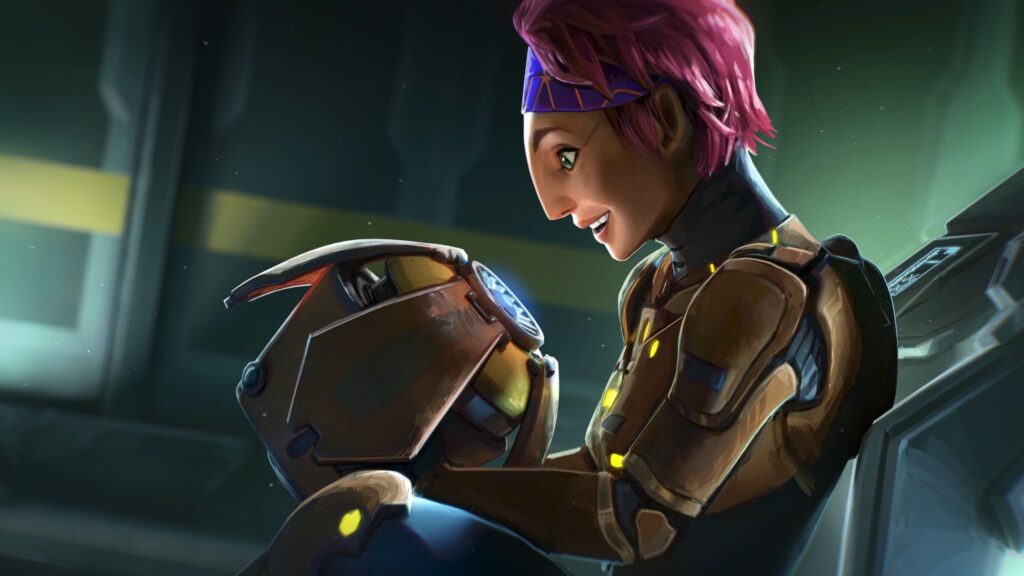
Maeve once worked for the evil galactic megacorp Astral Resource Corporation (ARC) as a mining engineer, but she’s recently branched out on her own as an independent. She’s recently inherited her own claim from her grandfather, an abandoned area of a planet thought to lack valuable resources, with Journey to the Center of the Earth-like biomes in layers underground (don’t ask where the light comes from, the camera doesn’t angle upward enough to see as if to prevent inquiry). These biomes turn out to be covered in the abandoned buildings and complexes of a failed scientific outfit, and as you progress through the game’s plot, you learn about what went wrong and why.
To do so, you’re going to be mining everything. Maeve is accompanied by a cheerful floating orb called Roland, who is equipped with a mining laser, used to blast ore from rocks, uproot vegetation, and gather valuable gems and materials. These rapidly fill your inventory, so you head back to your self-built base (at first essentially a shipping container, and by the end of the game an enormous complex of linked rooms, specialist units, and all manner of benches and machinery) to offload them into containers and processing machines, before heading off once more. The resources are used to build new machines, crafting opportunities and facilities, and the valuables sold to ARC to buy new crafting blueprints, vital upgrades for Roland, and decorative items to make home feel homely.
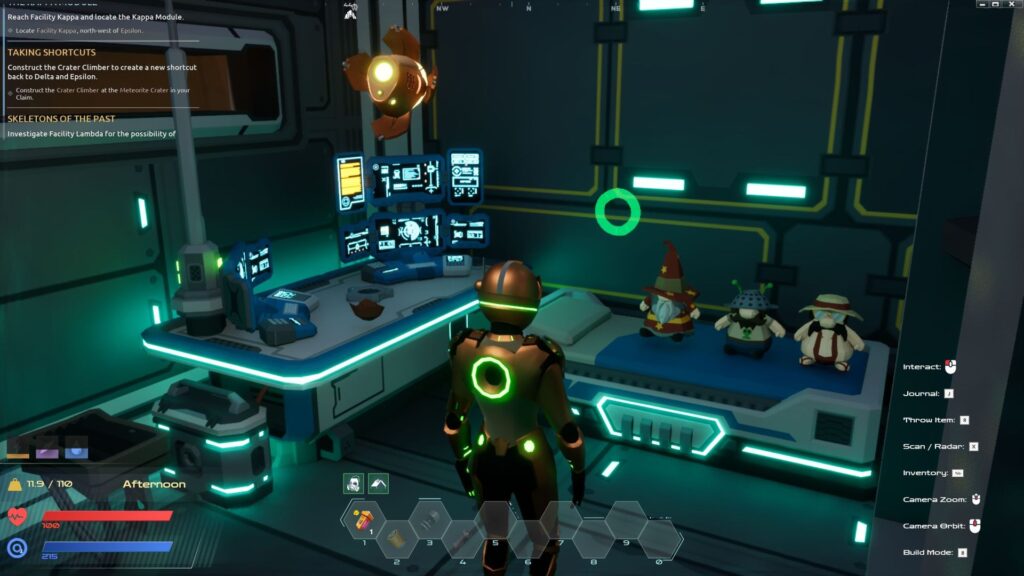
And yes, if you’re thinking Subnautica, I’m pretty certain that’s a primary inspiration here. Although this is a significantly dryer, chattier game. Maeve and Roland frequently exchange banter, their Scottish accents a rare treat in video games. Maeve’s voice is delightful, and I’m fairly certain many will enjoy Roland’s exuberance a bit more than I did. He sounds very much like David Tennant at his most excited, and that isn’t something I particularly enjoy when Tennant does it either, but I’m aware I’m in the minority. Both are extremely good performances, and they’re just two of many voices you encounter, which is all the more impressive when you learn this game is primarily the work of a solo developer.
Extraordinarily, Alex Kane (formerly of Rockstar) is the primary developer behind this entire narrative survival game, and this becomes more remarkable when you realise its scale and intricacy. It feels like no corners are cut in such an enormous project, with constant variety in its zones, the superb cutaway buildings you can craft and connect, the vast, vast numbers of carefully designed assets, a genuinely splendid UI, and always amazing lighting.
Something else that really stood out to me as I played is how much is in Aethus that isn’t even close to plot-critical. You can build entire farming structures, growing huge numbers of crops useful for both food and medicine, and spend hours getting this running exactly as you want. Or you can do what I do – I am not one for farming games – and just have a couple of beds to grow what you absolutely need. Many will wile away a very happy evening buying crafting plans for the squillions of decorative items for your base, making the perfect home, or if you’re lazy like me you can drop a bed in the corner of a residential unit (or anywhere else for that matter, but you get better rest stats in the right room) and be done with it.
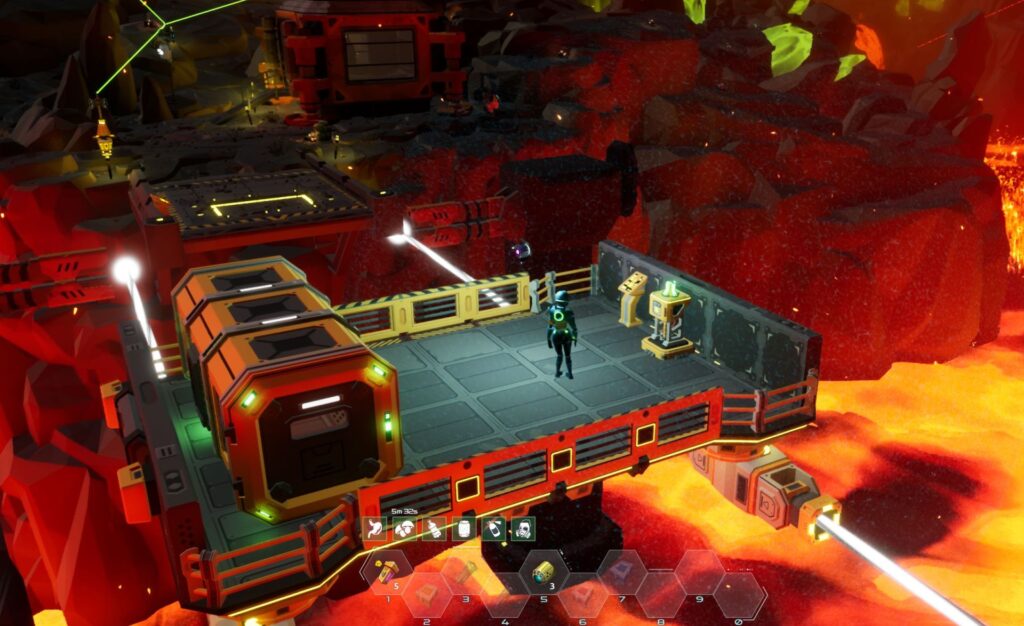
Aethus, despite the strong plot that drives you forward, is very definitely a mining-crafting loop game. And that’s a happy place for me. It does mean, however, that there will be times when you have to put aside your plans for deeper progress to go on more basic mining runs in earlier caves, gathering enormous piles of resources to process in order to build stacks of vital items needed to build the tools and equipment you need to continue further down. These runs are very pragmatic, and given the urgency of the storyline they can feel like interrupting moments. The solution is to adjust your philosophy, to head off on these runs with a sense of purpose, and to stick on a podcast as you complete your busywork. And honestly, those have been some of my favourite times while playing, leaping to press pause as Maeve or Roland pipes up to discuss their predicament (and I should stress, there’s no repeated dialogue at all).
However, one criticism of a game that is being frequently updated in response to player feedback is a bit too much back-and-forth in the first half. No matter where you set up your base in the relatively small opening surface area, you’re going to spend too much time running from one place to another to ferry rocks. In the second half of the game there are all sorts of splendid shortcuts that become available for the farther reaches, but I think it might be an idea for dedicated research to perhaps allow some form of transport system after a good few hours. (There are abandoned drills you can power up, and then set up with drones to deposit ores to your base, but it doesn’t come close to replacing all the running around.)
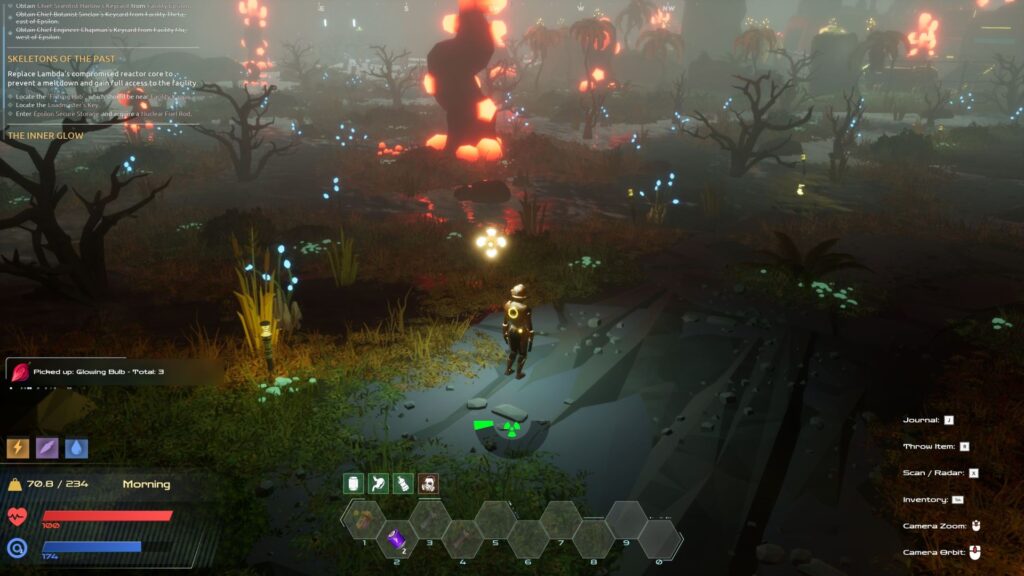
Another criticism would be the fall damage. Maeve is a delicate thing, incapable of stepping off a curb without doing herself an injury, and that’s genuinely fine for the first half of the game. You just learn you don’t jump off ledges. But a lot later on you’ll gain technology that lets you make impressively bouncy leaps, and here her apparent brittle-bone disease becomes a lot more problematic – the larger leap is accompanied by the ability to “float” back down, but it makes even her small jumps now seem to break her ankles, and it’s very counter-intuitive in the world of gaming (no matter how realistic in the world of actual gravity) to be able to jump higher than you can safely land. (I should stress that damage very quickly heals, but I did manage to literally kill Maeve far too often because I jumped over a gap.)
Like I say, Kane is rolling out enormous numbers of updates in response to player feedback since the game launched 10 days ago. There’s a fair chance just my saying the above could see it change in a future fix, and it’s been brilliant to see the responsiveness to comments on the Steam discussions for Aethus. Hotfixes have rolled out literally hours after complaints have been made.
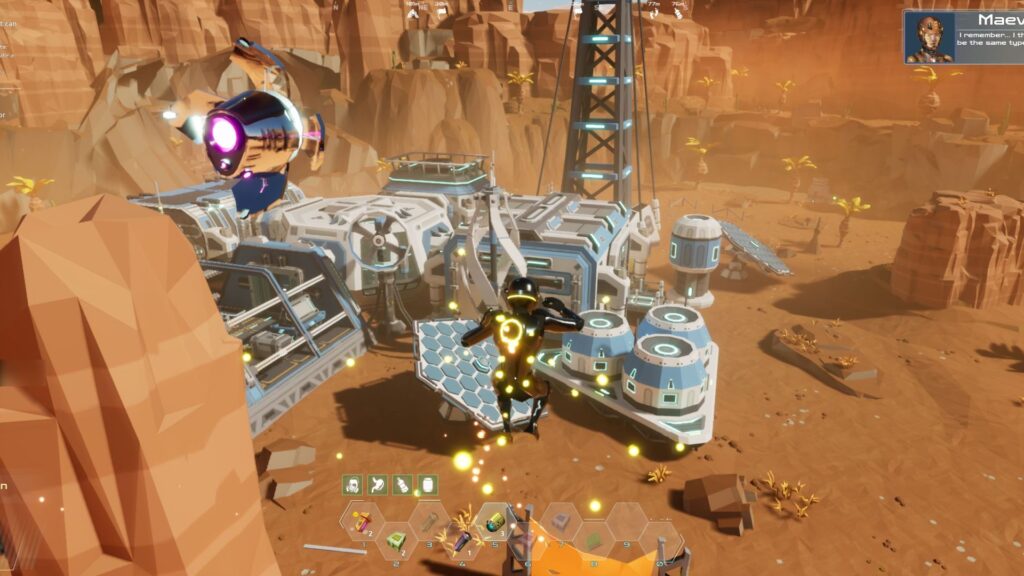
I mentioned Subnautica above, and while I really don’t want to make unfair comparisons to games made by far larger teams that Aethus can’t fairly meet, I’m going to do it again anyway. But carefully. Because in a way that is much more about attitude than how you actually play, I was also frequently reminded of System Shock. This is a combat-free game, so not in that sense at all, but rather in the nature of exploring an abandoned location replete with plot-driving notes, lost keycards, hidden door codes, and the overall fight against a sinister force (in Aethus‘s case, ARC). God, I’m not saying this game is “a cross between” because can you imagine the money and workforce that would require (but please, somewhere, make that game!), but how splendid that a solo-developed game can even evoke such all-time classics.
So temper exaggerative notions based on such comparisons, because this is after all a solo indie project. And a brilliant one, that manages to combine its crafting loops with a fun, surprising story and a constant sense of satisfying progress. It also delivers a great ending, with a tense climactic finish, and then the good nature to allow you to return to before that moment to continue on surviving in your base should that be your jam.
I’ve had a tremendous time with Aethus, a whole week’s worth of fun (sorry, Kotaku). It’s very highly recommended.
- Pawsmonaut Games
- Steam
- £13/$16/€16
- Official Site
All Buried Treasure articles are funded by Patreon backers. If you want to see more reviews of great indie games, please consider backing this project.
86
















Just to add that there is a demo available …
I saw this in the new release listings a couple weeks ago, and didn’t give it much of a second glance — but this sounds like a much more interesting environment to explore than I’d realized, and that really does appeal.
So: thank you for putting in the work!
Abiotic Factor strikes me as that “cross between” Subnautica and System Shock. Well worth checking out!
Lost nine days of my life to this game thanks to you. No really. Thanks to you. I really enjoyed it. Never would’ve heard of it otherwise.