
PC, Mac
At university I was in love with a girl. She did not love me. More embarrassing, she was in a relationship with someone else. A nice guy, but a crappy boyfriend. She and I spent so much time together that others assumed we were a couple. We were inseparable in classes, skived lectures together, and would hang out in her dorm until the small hours, talking with enormous passion about the controversial theology we were studying, or the bands we adored, and these intense and splendid evenings were only spoiled if her (very decent) boyfriend showed up and brought everything down with his crass humour. Humour I really enjoyed. I liked him—that only made it worse. I was the worst. This simpering buffoon who willingly performed all the emotional and intellectual roles her boyfriend did not. I was the one who stayed up with her all night as she finished an essay, not him. I was the one who listened to her rant about how her boyfriend let her down. It all felt worth it because it meant I got to be with her, in her incredible aura, and I loved her so very much.
It all eventually came to an inevitably sad end. How it took so long for her to realise I do not know, but she eventually realised. I remember her coming over to my flat, saying, “You’re in love with me, aren’t you?” And saying yes. And our realising this had to be it. We broke up. I broke up from a relationship I was never in. God damn. We didn’t see each other for months, and then when we did, it felt different, new, appropriate. And gradually our lives grew apart. The last time I saw her was 15 years ago when she came to my wedding.
Perfect Tides: Station to Station – one of the most beautiful and important games I’ve ever played -brings this all back to the surface, flooding me with raw, visceral emotions of joy and humiliation, elation and crushing sadness. I don’t miss it, I never want to go back to it, I’m so incredibly fortunate as to be in a loving, happy marriage with a wonderful person whom I adore and who adores me back. But those evenings, sat on the floor of a dorm room with that magical girl, being so excited by this dangerously interesting person… God, it’s painful and exhilarating.
I expose all this part of my long-ago life because PTStS almost demands that honesty from me. If you played the previous game, Perfect Tides – one of my favourite games of all time – you’ll already be halfway to understanding why. I’m so delighted to tell you that Station to Station is an even greater, even better-written, even more extraordinary game. While none of its stories of the tribulations of college relationships directly mirror my own, there’s enough overlap that I felt it hard. This is a game that evokes truth in a way that I believe has few parallels in gaming.
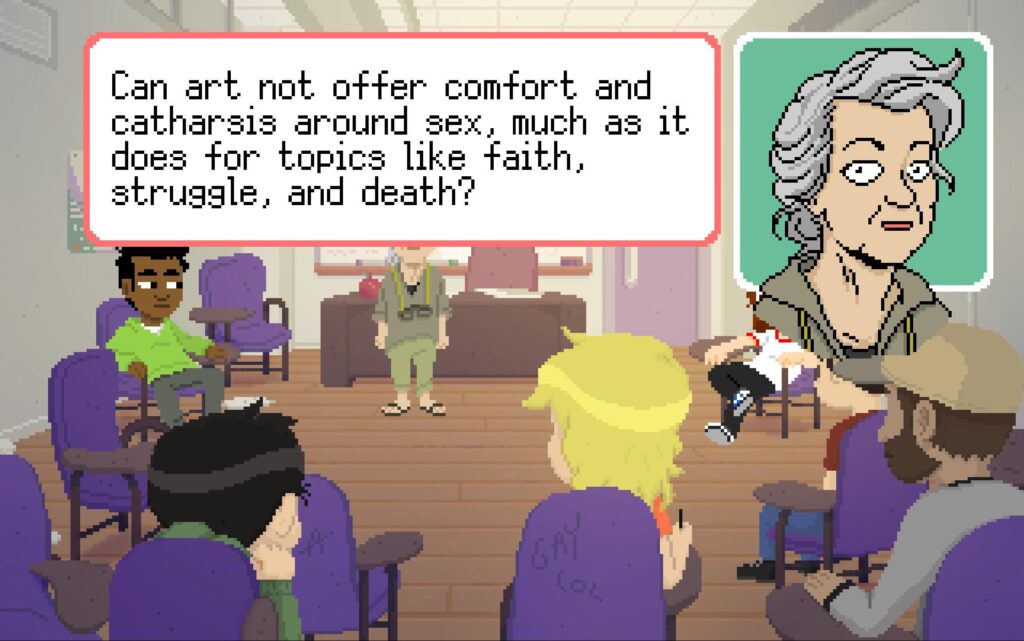
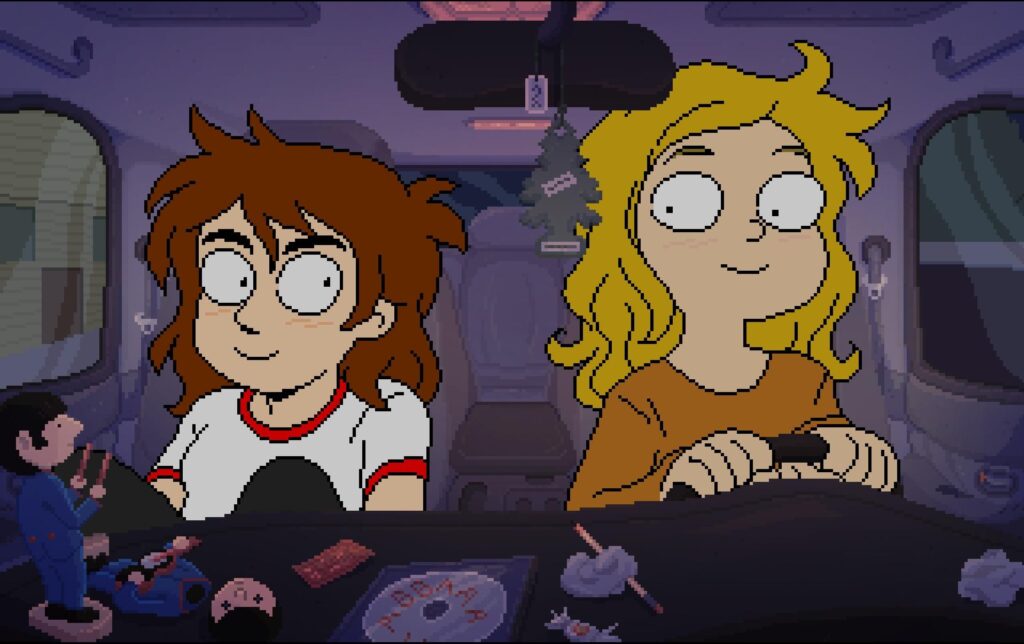
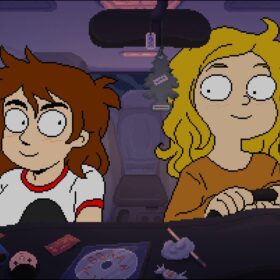
2022’s Perfect Tides depicted the life of late bloomer Mara Whitefish at the age of 15, during the turn of the century, as she dealt with the perils of puberty, the hinterland between childhood and adulthood and the desperation to be in both phases of life at once. It was a magical game, a work of such profound intellectual and emotional honesty, and anyone who was a teenager in that era (and I just count) could identify so strongly with so much of its early-internet-driven reality. Station to Station revives this philosophy, the story opening toward the end of Mara’s first year at college before spanning the course of a year. She’s in The City, which is New York in every detail but name, studying creative writing, and still existing in awkward transition. She’s living at home, in her mom’s new apartment a train ride away, but crashes on the couch of her best friend Daniel most nights so she can be in the city. And be near Daniel.
Mara at 18 is still woefully prone to blurting out her inner monologue. She’s helplessly honest when she’s not lying to herself, leaping head-first into half-formed opinions and then cruelly chastising herself for doing so, always certain she’s made a fool of herself, convinced she’s an irritation to all around her, sometimes so much that she fulfils her own greatest fear. It’s in parts adorable, frustrating and painful to watch, this clearly fantastic person incapable of letting herself just be fantastic, instead being self-sabotaging or outright idiotic. And rightly, she has people in her life who love her, who love to hang out with her, Mara only sometimes able to receive this.
Mara also began college with a long-distance boyfriend. And no matter how much I tried to remind myself that this is a work of fiction, I loathe him. He is just the most obnoxiously vile person, the sort who behaves like a victim to control others, who plays with the tools of coercive control, and who deliberately manipulates Mara in ways that make me want to climb through the screen and find him.
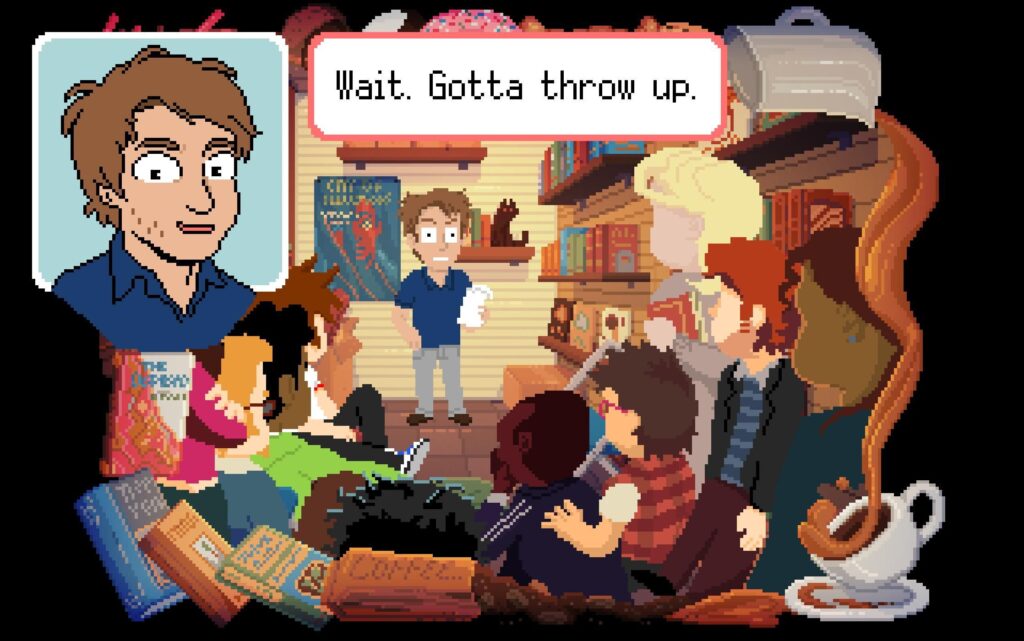
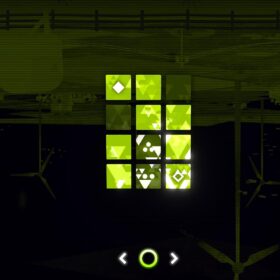
New to Station to Station is a completely novel system in which Mara can pursue interests in a range of subjects, with greater knowledge and experience literally shaping her understanding, depicted as an increasingly detailed polyhedron in her mind. She can also read books, one a day, that will further shape her thinking and views, and you genuinely have a broad range of choice over which to read. This not only determines her experiences during certain events, but also informs her writing in the various assignments and projects she’s set throughout the year. It’s up to you to find the time to sit at a computer and complete this work, picking from two of the subjects you’ve explored, with the results determined by those choices. If this sounds daunting or fiddly, do not worry at all – it’s as simple as picking two subject titles, and not only naturally flows with the story but importantly defines it.
As much as you can make decisions for Mara, she’s always capable of sabotaging your best intentions, either by her erratic impulses or crushing self-critique. (Which is a nice way of saying, while you certainly get to make some important, plot-defining choices, many of these purported choices are more about you than her.) My most frequent refrains while playing, out loud, were variations on “MARA!”, “Oh Mara”, and “Oh no, oh sweetheart.”
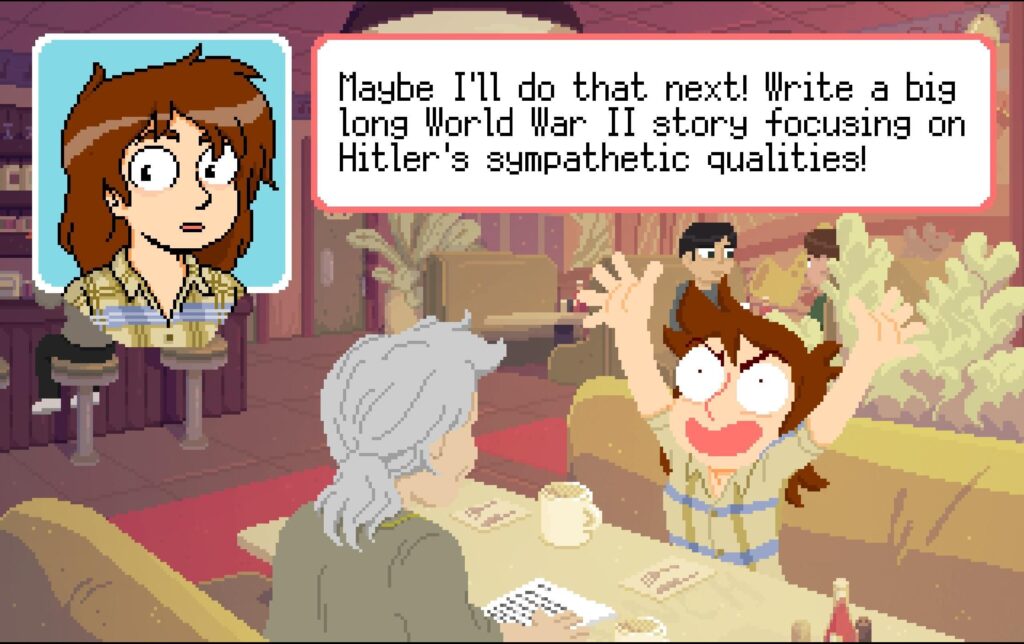
In Perfect Tides, it was tempting to try to distance yourself from Mara’s turmoil on the basis that she’s “only a teenager” and these fleeting crushes, or embarrassing events, would eventually become tiny memories in her adult life. That’s an inherently spiteful reaction to the lived reality of a teenager, but still a tempting one. One of many aspects that makes Station to Station is so extraordinary is how intricately it interrogates this thought, as Mara at 18 continues to try to litigate the cruelties of her adolescence as if she were the impotent victim of the gods. In rightly claiming these incidents as significant and defining, she then keeps running with the ball to a place of undignified solipsism. And yet, at the same time, the relationships she’s having now are defining, and will shape how she approaches life. As one infects the other, this game explores a part of early adulthood that I think is rarely given attention, and it does it so spectacularly well.
As I’ve said, Station to Station is truthful about being 18 in a way that feels rare and precious. It depicts Mara’s discovery of topics like anarchy and Marxism in a way that’s so rawly honest, that wonderful sense of finally have answers to everything that’s felt wrong about the world, of wondering how everyone else hasn’t already figured this out! And we as the older observer can choose to patronise this, and thus ourselves, or to allow ourselves to be exposed to that rawness an a way that forces introspection and reevaluation.
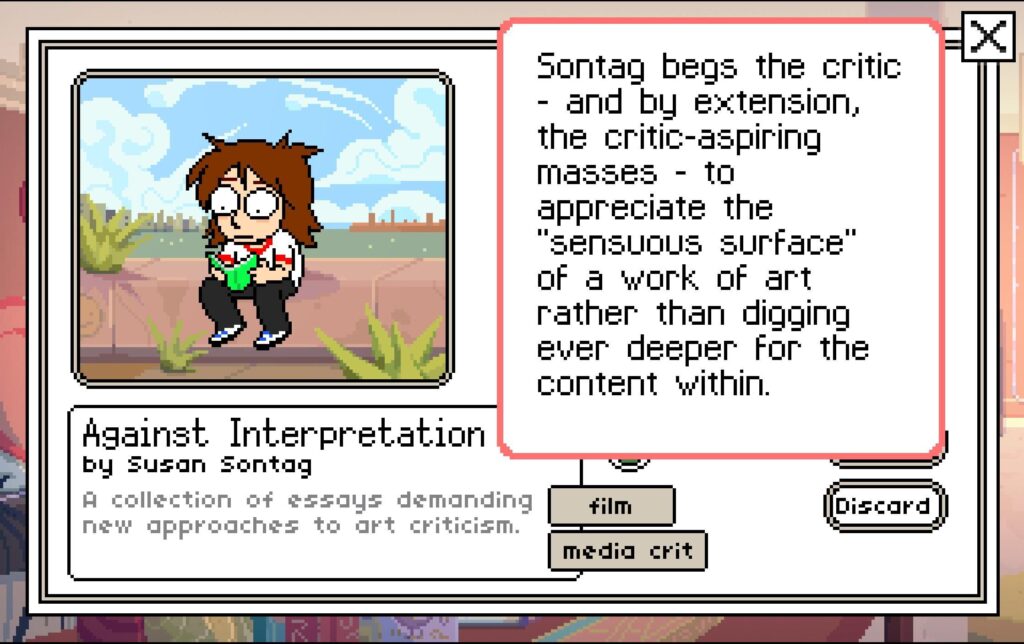
At the same time, this beautiful game also captures observations so tiny that it feels like creator Meredith Gran has invaded my mind. In Mara’s grandmother’s house is the room she would stay in as a child, and in that room is a wardrobe that only ever contained things like old curtains. This monolith, an object of her past that was at once significant and utterly banal. I remember that wardrobe. Or the way Mara refreshes an internet forum after leaving what she is convinced will be the furious comment that demolishes every argument, only to see people replying to the comment before hers.
This is all elevated by the crisp, delightful writing, that’s never pretentious (unless deliberately) and so often poetic and spiriting. Nearly every detail in every location (of which there are so, so many) is described, sometimes with a surprising lengthy diversion of wonderfully observed thoughts, or simple one-liners that take me by surprise and make me laugh loudly.
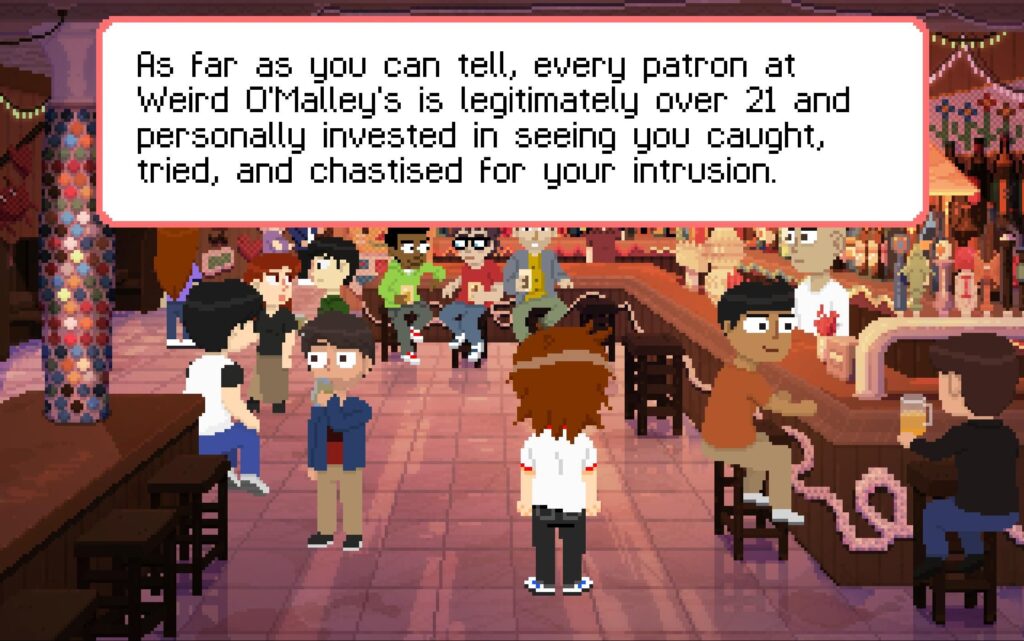
I have very carefully avoided giving you a single detail of the story that unfolds, and that’s not about to change. So dancing around it extremely carefully, I also need to tell you that Station to Station features a scene that I think should go down as one of the most extraordinary and delightful in all of gaming. It’s karaoke, that’s all I’m saying, and it will live with me forever as one of the most wonderful ideas I’ve ever seen. I implore you to take the game at its word and do as it asks at this moment.
I want to keep writing about this forever. I’ve deleted literally hundreds of words of irrelevant anecdotes and lengthy asides on my love of the space between Before Sunrise and Before Sunset, because I am compelled to do everything I can to let this game be known, and let it be known how much I love this game. I was honestly afraid to play it, worried it wouldn’t live up to Perfect Tides, but I can tell you that it exceeds it in every regard. And I haven’t even mentioned the magnificent music, the lovely art, the infectiously gorgeous animations…
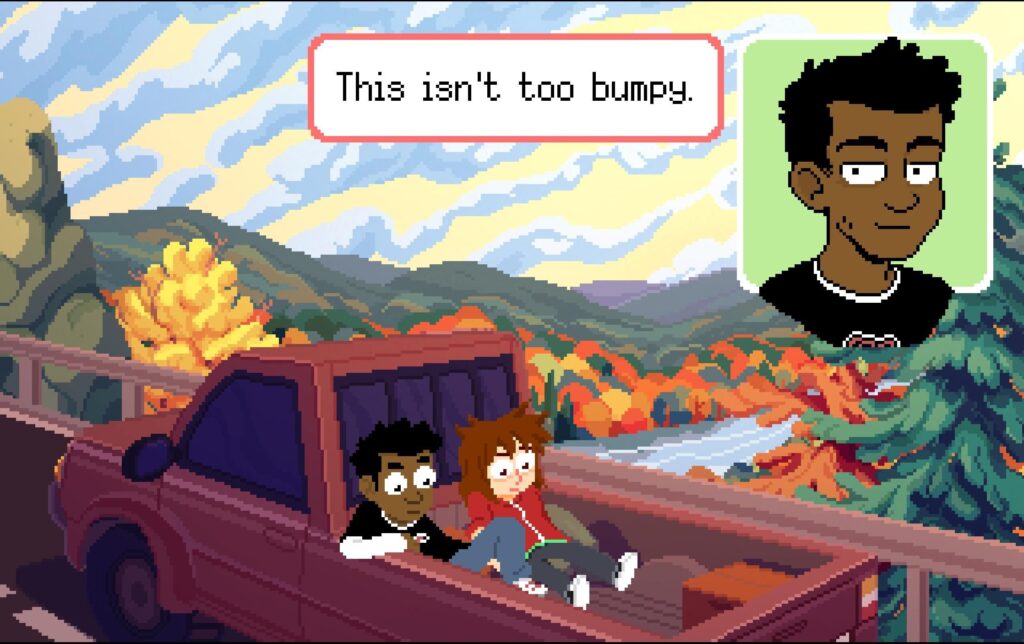
Station to Station is often hilarious, often mortifying, and perpetually honest. As Perfect Tides so wonderfully depicted incredible specifics of adolescence, this sequel speaks as truthfully and intricately about the emerging of adulthood. It captures those moments of profound bliss and shattering devastation, alongside the beauty in the mundanity between. And it makes me miss those times with that magical girl from university, and so unbelievably grateful it’s so long in the past and never to be repeated.
- Three Bees
- Itch, GOG, Steam
- $15 (GOG, Itch), $20/£17 (Steam)
- Official Site
All Buried Treasure articles are funded by Patreon backers. If you want to see more reviews of great indie games, please consider backing this project.
95










What a beautiful piece of writing, it was a joy to read 🙂 I haven’t played this series yet, but definitely planning to!
That sounds great! I’ve been looking forward to a review after you’ve made me aware of the original Perfect Tides (big fan). Now I certainly need to purchase the sequel…
Oh wow, John, I also knew that girl but I was only 14 or 15 at the time. I, too, was the one who listened (although that wa very much mutual) and worse, I *didn’t* like her dumb, boisterous boyfriends (yeah, plural, in sequence) but of course it was me who consoled her when things inevitably went awry. She, too, found out after some time, but we managed to make it work until my teenage infatuation passed into just deep friendship. But we, too, went our separate ways after a while. I met her again a few years ago high-school reunion. We’re both married with kids but there was still a kind of recognition of a very special rapport and it felt good to catch up.
Anyway, this sounds like a very special game to dig up these memories and I’m generally a sucker for coming-of-age stories. Perfect Tides has been on my wishlist since your review and I guess now I really have to move it to the top so I can also experience the sequel.
I also appreciate how you write about (writing about) teenagers – it’s lazy to write off what they do and how they feel as just-so but it still happens a lot.
Well this was a lovely article, very much enjoyed this one in particular. ^w^
I think I connected a lot more with the first game as I never experienced anything like what happened in this game. Mara kind of annoyed me at times for being so reckless at continually seeking out something that kept breaking her and not seeing how her silence contributed to hurting others. Fantastic writing throughout though.
Just discovered this site via a recommendation from Second Wind and this was a great writeup. I recently reviewed Videoverse and that elicited similar feelings for me that you’re describing here, to a point that I almost felt like I was too much the target demographic to even offer any objective opinion on it.
Adding this to the Steam wishlist now, thanks for the review.