
PC
Let’s start with the context: I’m writing about Spare Parts: Episode 1 because one of my supremely wonderful Patreon backers, Emily, has requested it. (Woefully long ago – I am the worst.) I wouldn’t usually review a straightforward visual novel because it’s just not a genre I click with, and thus one with which I’m not widely familiar, and as such I am not a particularly useful person to inform the games’ audiences. So it’s in this light that I write the following, not as a guide as to whether you should want to buy Spare Parts (people seem to like it a lot), but rather my own personal reflections on it.
When it comes to visual novels, I’m very thinly read. I’ve played a few, but never really found a love for the genre. That’s usually due to specific issues (detailed below) that seem to plague nearly every example: over-writing, over-explaining, under-justifying and an infuriating lack of nuance. But also I struggle with the performative elements of “game”, those moments when you’re asked to click on one of three options, but then click on a second, and then the third, and the choice was a pretence. Clearly many VNs offer genuine choices, moments that steer the narrative down a particular path, or pick a specific romantic thread, but these are (usually by necessity) colour in a prescribed text.
There are exceptions, of course. The extraordinary Scarlet Hollow games would be the most outstanding example, a work of incredible intricacy where a vast array of crucial decisions dramatically (literally and figuratively) change the nature of how the narrative is told, remembered across multiple chapters and as significant as whether people die, or live on to play a part in the future story. But Black Tabby’s gifts are rare, and their achievements aren’t usually even desired by the writers of VNs. The goal is more usually to tell a story. And to be clear, there’s nothing wrong with that. It’s a noble goal. It’s just that personally, I’d prefer to read it in a book and not have to bother with all the left-clicking.
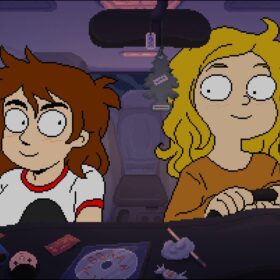
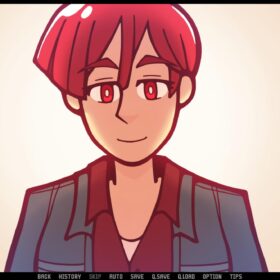
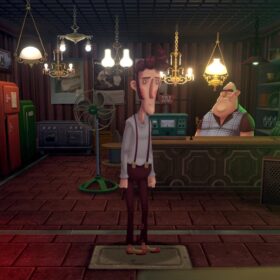
I really like Spare Parts‘ attitude! I like it’s doofus protagonist, Lucy, a klutzy and likeable 20-something with no direction in life and a stunning lack of self-confidence. I like the game’s cheerful demeanour and bold, colourful artwork. It’s a fun space! But I haven’t enjoyed it. And that’s primarily because, despite being perfectly competent, the writing doesn’t grip me. The words are in all the right places, there are none of the grammatical issues that plague too many VNs, and it certainly knows how to string a sentence together! But I just can’t get along with it.
The main issue here, and it’s one true of too many visual novels, is the lack of an editor. If the prose from most VNs were put on paper and sent to a publisher it would receive the slashing that’s so often desperately needed to let a story flow. This is primarily about over-writing, where every tiny thought is enunciated, every feeling described, in a way that leaves nothing to the imagination other than the Deliberately Unsaid Thing. That trope, the painfully obvious element that the protagonist is somehow unable to perceive, becomes underlined and floodlit when all other nuance is removed by the abundance of descriptions. And it’s usually all accompanied by a prevalence of ellipses no editor would ever permit. No one… writes or… speaks
…
……….
…
like this… and I find it extremely frustrating. I recognise that it’s born primarily of RPGs primarily from Japan, where the ellipsis is used to represent moments of pause, thought, shock or contempt, and it annoys me there too, but in the VN it has metastasised into something far more outlandish. Clicking through multiple text boxes that contain nothing but a row of full stops offers nothing to anyone, and yet is de rigueur.
It also doesn’t help that the central conceit of this first chapter – a 23-year-old who gets a job at a Spare Parts shop run by a woman who is so obviously a robot that it hurts, but isn’t aware that her new boss is a robot – is an exercise in frustration. You might think I’ve revealed some sort of spoiler here, but from the moment you meet the boss she has red glowing eyes, speaks robotically, isn’t aware of temperature, and introduces herself as “Unit 01.” So, you know, there are possibly a couple of early hints.
Lucy, however, is somehow oblivious, deciding this woman’s name must be “Owen” and forcing the player to read through her perpetual confusion as to why this really obviously a robot lady might not realise Lucy needs breaks, or to go to the toilet, or have heating, or eat food… By the end of this first chapter, perhaps five hours long, I genuinely couldn’t tell if Lucy’s “revelation” about her was intended to astonish a terrifyingly credulous audience too – was I really supposed to be unsure if the robot lady was a robot? And if not, why the hell was Lucy so impossibly stupid? (I can imagine attempts to justify this with, “But in real life you wouldn’t be able to believe it could be true!” But no, seriously, from the moment she finds the sci-fi basement full of sci-fi pods…. eerruuugghhhhh.)
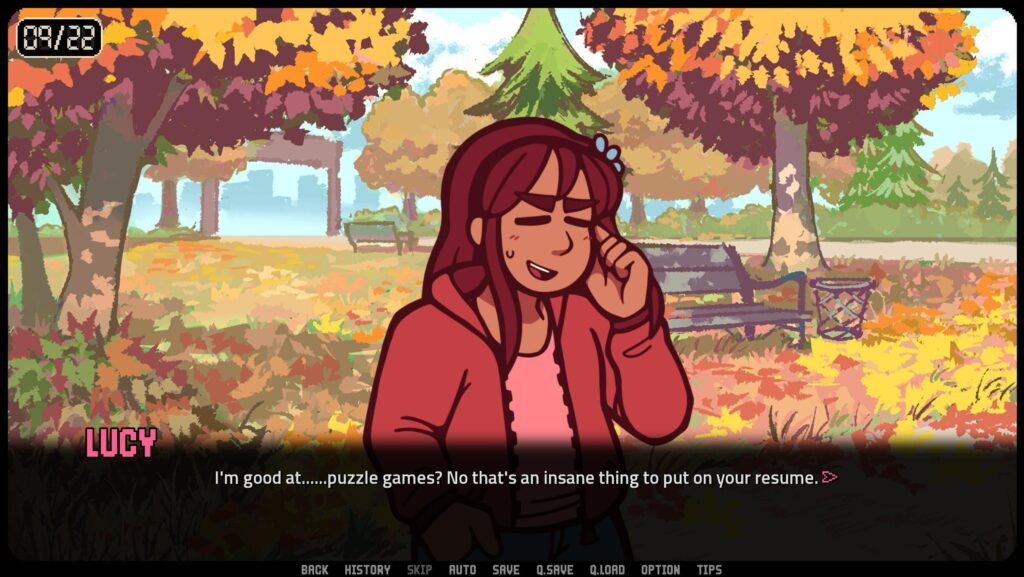
I’m also left unconvinced by any of the romantic plot here. It’s hard to explain why without spoiling the story, but it’s all utterly without depth, a narrative conflation of one’s being attracted to someone with having deep, informed feelings for that person. Something that’s made all the more ridiculous when the writing has provided the person involved with literally no personality at all. And again, I kind of get it, I get that this is how VNs work, these facile attractions portrayed as if life-changing connections. In some ways they work like period costume dramas, someone glanced from across a room becoming the target of proposals, and I find it as uncompelling here as there.
If it were a plot is about someone wanting to get laid, then sure, this works, but instead the audience is asked to believe in some sort of profundity. It’s as if it’s thought possible to short-cut to the passionate shipping a television audience asks of long-established characters, but just because they’re the only two people in the room.
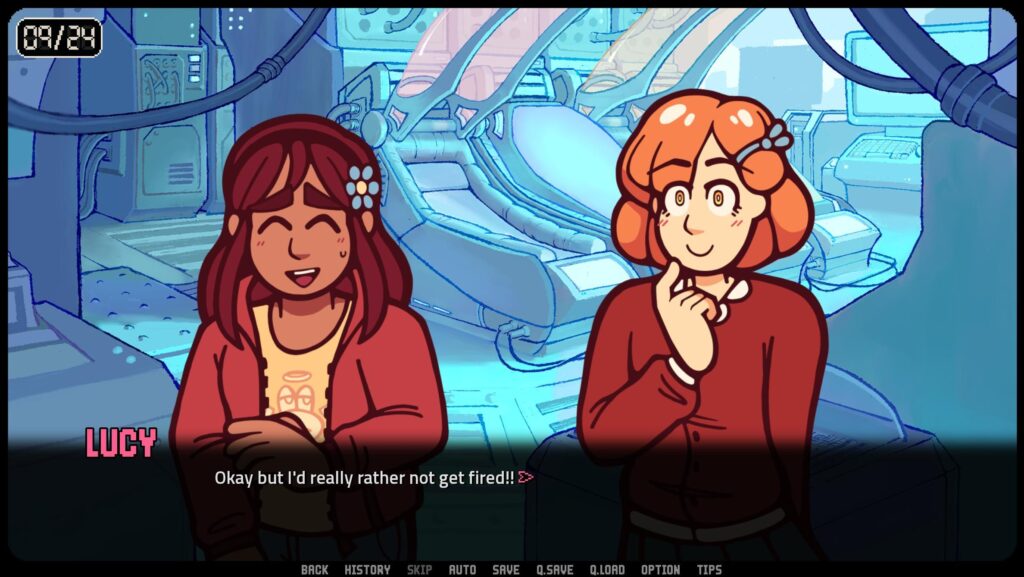
I can imagine a version of this first episode of Spare Parts where the gentle sci-fi tale is told in an hour, and almost nothing of any material would be lost. Cutting out 90 percent of Lucy’s internal panic would in no sense remove anything from her character, but instead let the story flow. Once established, and then occasionally reprised, we’d be able to assume her personality is always there whether written out or not. Instead I’m left wanting to shout, “I GET IT! I GET THAT SHE’S NEUROTIC! STOP TELLING ME!” Or worse, tempted to just click past those moments, and risk missing the occasional moments of narrative development.
That brutally shortened version could create a tale of some intrigue, where instead of being asked to be the credulous onlooker for hour after hour of someone’s impossible naivety and incuriousness, we instead had all the pieces put in place for the mysteries to be explored in Chapter 2 (which is out too). But, and I cannot stress this enough, I know this game isn’t aimed at me!
So take this as my explanation for why that’s the case, rather than an indictment of Spare Parts. Clearly lots of love has gone into it, and clearly there’s a big audience who wants games to be written like this. It’s loved by Emily and many others, and I feel like a big bully for being mean about it. But then, you know, I was asked to write a review of the game! (I’m assured Chapter 2 gets the story moving, but, you know, it’s obviously not my thing.)
- Sophie Rose
- Steam
- £2/$3
- Official Site
All Buried Treasure articles are funded by Patreon backers. If you want to see more reviews of great indie games, please consider backing this project.






Agreed. Video game writing, VNs included, seem to think that more words is better. It is just dreadful to read.
I tried it and it’s truly terrible. Every night I read children’s books to my son and they’re better than this.
The “…”s are generally a sign of someone trying *harder* to capture the cadence of speech or conversation through the zero-narration dialogue-only conventions of the genre.
Successful deployments manage through context or character art convey to the reader nature of the pause, where conventional narration might use an “I stammered” for a mid-sentence … or a “the conversation broke down completely as I floundered” or “we fell into a comfortable silence for a time” in place of full dialogue box of … silence.
But they’re not all successful. If the reader has no earthly idea why there’s a moment of silence (as seems to be the case here, unless John is just complaining?) then the beat has whiffed.
Separate thought: I’m curious what John would make of something like Umineko: When They Cry, where there is a genuinely compelling and knotty mystery — but still just as little subtlety or finesse to most of the moment-to-moment dialogue and action. With it being 70 hours for the Umineko Question Arcs, I probably can’t reasonably push for an answer to this curiosity, though.